SSPC and NACE standards in sandblasting and painting
In the oil, gas, petrochemical, marine and metal structures industries, combating corrosion is one of the most important challenges. To prevent this problem, sandblasting and surface coating must be carried out in a completely standardized and principled manner. Two important and globally recognized standards that determine the quality of surface preparation are SSPC and NACE.
In this article, we will fully explain what these standards are, what their differences are and why they are important in industrial projects.

What is SSPC?
SSPC stands for Society for Protective Coatings.
This American standard is one of the most authoritative references for determining the level of preparation, cleanliness, and quality of industrial sandblasting and painting.
SSPC examines the condition of the metal surface in terms of cleanliness, roughness, removal of contaminants, rust, and adhesion.
What is NACE?
NACE stands for National Association of Corrosion Engineers.
This standard is primarily concerned with corrosion engineering and its control in the oil and gas industry, pipelines, tanks and offshore structures.
This organization publishes specialized guidelines for corrosion prevention, coating selection, inspection and surface preparation.
NACE and SSPC merger
In recent years, the two organizations have merged and created a new standard called AMPP.
However, the former names SSPC and NACE are still widely used in projects and contracts.
Important SSPC standards in sandblasting
1. SSPC-SP1 – Solvent Cleaning
This standard includes the removal of grease, oil, salt, contaminants and dirt.
2. SSPC-SP2 – Manual Cleaning
Performed with hand tools such as wire brushes.
3. SSPC-SP3 – Power Cleaning
Uses grinding wheels, rotary tools and power tools.
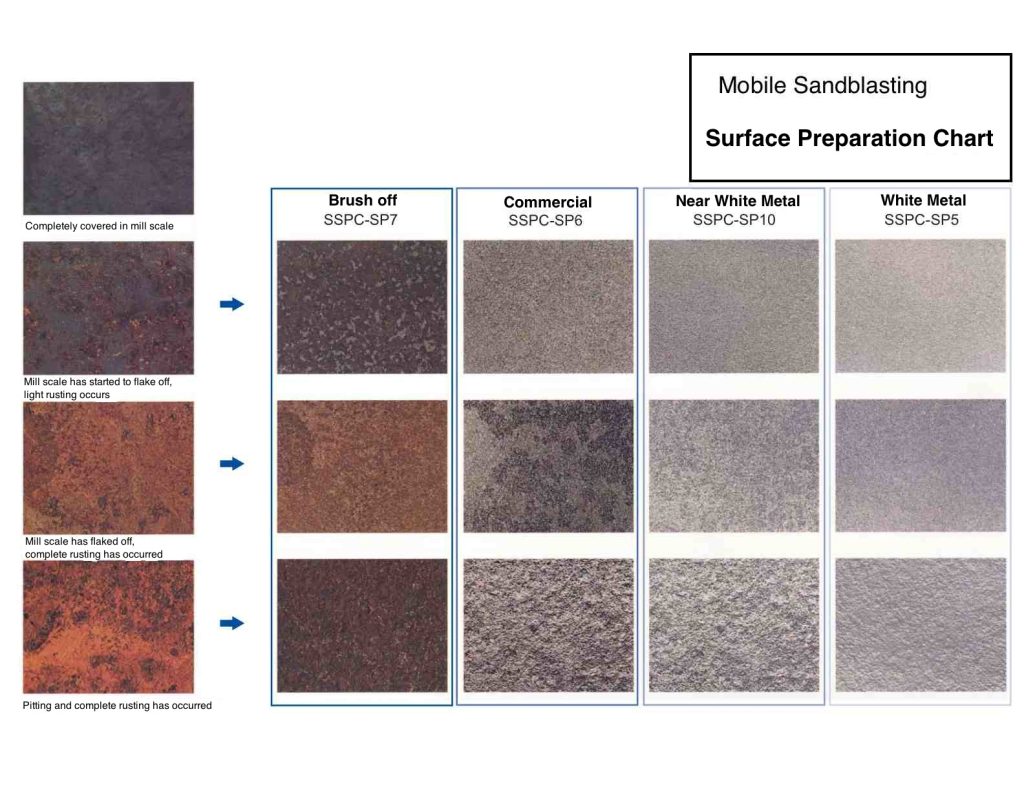
4. SSPC-SP5 – White Metal Blast Cleaning
The cleanest and highest level of preparation.
99% of contamination and rust is removed.
5. SSPC-SP6 – Commercial Blast Cleaning
Relatively clean but not as clean as SP5.
Suitable for structures, bridges and tanks.
6. SSPC-SP7 – Brush-Off Blast Cleaning
Minimal stripping to allow paint adhesion.
7. SSPC-SP10 – Near-White Metal Blast Cleaning
Popular standard for oil and gas projects.
95% of the surface must be free of contamination.
NACE equivalent standards
NACE has similar standards to SSPC, which are usually equated in technical documents. Example of Equivalences:
| NACE standard/th> | SSPC equivalent | Description |
|---|---|---|
| NACE No.1 | SSPC-SP5 | Full white sandblasting |
| NACE No.2 | SSPC-SP10 | Almost white sandblasting |
| NACE No.3 | SSPC-SP6 | Commercial sandblasting |
| NACE No.4 | SSPC-SP7 | Light sandblasting / Brush-Off |
Difference between SSPC and NACE
Although both standards are used to determine the quality of surface preparation, they have some differences:
1. Scope
SSPC: Focuses on industrial coatings and paint
NACE: Focuses on corrosion engineering, cathodic protection, coating selection
2. Type of standard
SSPC focuses more on surface cleanliness and preparation.
NACE also addresses corrosion, inspection, and coating performance.
3. Scope
In large oil and gas projects, a combination of both is usually used.
Why are SSPC and NACE standards important in sandblasting and painting?
1. Increase the life of structures
By performing sandblasting according to the standard, the paint adheres better and the life of the structure is increased.
2. Reduce maintenance costs
Non-standard execution causes paint peeling and rapid corrosion.
These problems are much more expensive to correct.
3. Mandatory in Oil & Gas Projects
Almost all oil, gas, petrochemical and offshore projects directly reference SSPC–NACE standards in their contracts.
4. Safety and High Quality
The standard preparation level ensures that the highest quality protective coating is applied.
Conclusion
SSPC and NACE standards play a fundamental role in the quality of industrial sandblasting and painting. Compliance with these standards makes structures more resistant to corrosion, increases their useful life and reduces maintenance costs.
If you are working in the oil and gas, petrochemical, marine or metal structures sectors, using these standards is a necessity, not an option.